Top 7 Aerial Shots of Indian Monuments That Will Make Your Film Stand Out
Imagine this: a documentary opens not with a talking head, but with a slow, sweeping drone shot gliding over a 900-year-old minaret as the morning mist lifts. That single frame does more storytelling in five seconds than two minutes of narration ever could. This is exactly why aerial shots of Indian monuments have become the go-to visual language for filmmakers, advertisers, and content creators who want their work to feel cinematic rather than ordinary.
India's drone-enabled filmmaking industry is no longer a niche experiment it's a genuine growth market. According to Markets and Markets, the Indian drone (UAV) sector was valued at roughly USD 0.47 billion in 2025 and is projected to more than double to USD 1.39 billion by 2030, growing at a compound annual rate of 24.4%. That expansion isn't limited to defense or agriculture; media, tourism promotion, and independent filmmaking are increasingly riding the same wave, powered by lighter drones, better stabilization, and simplified flight permissions under India's liberalized Drone Rules.
For filmmakers and marketers, this means one thing: aerial monument footage is more accessible, more affordable, and more expected by audiences than ever before. Here are the seven aerial shots that consistently elevate a film from “nice” to “unforgettable” — and how to use them well.
Why Aerial Footage Is the Secret Weapon of Modern Filmmaking
Aerial cinematography solves a problem ground-level cameras can't: scale. A drone shot instantly communicates geography, grandeur, and context — three things every establishing shot needs. It's also become a semantic signal of production quality; audiences on YouTube, OTT platforms, and social media have grown accustomed to associating drone footage with premium content.
The Regulatory Green Light
Part of this growth is regulatory. India's Directorate General of Civil Aviation (DGCA) has steadily eased restrictions since the 2021 Drone Rules, expanding visual-line-of-sight permissions and digitizing flight authorizations through the Digital Sky platform. For production houses, this has cut what used to be a weeks-long clearance process down to same-day approvals for many routine shoots a major reason aerial monument footage has become so much easier to license and produce commercially.
Top 7 Aerial Shots of Indian Monuments You Need in Your Next Project
1. Taj Mahal, Agra
The world's most photographed mausoleum looks entirely different from above. An aerial reveal shot starting tight on the central dome and pulling back to expose the full charbagh garden symmetry is one of the most requested shots in Taj Mahal stock footage libraries, and for good reason: it captures both intimacy and immensity in one move.
2. Qutub Minar, Delhi
As the tallest brick minaret in the world, Qutub Minar photographs beautifully from a top-down angle that emphasizes its tapering, fluted silhouette against the Mehrauli greenery. A slow orbit shot works particularly well for history documentaries and travel content.
3. Red Fort, Delhi
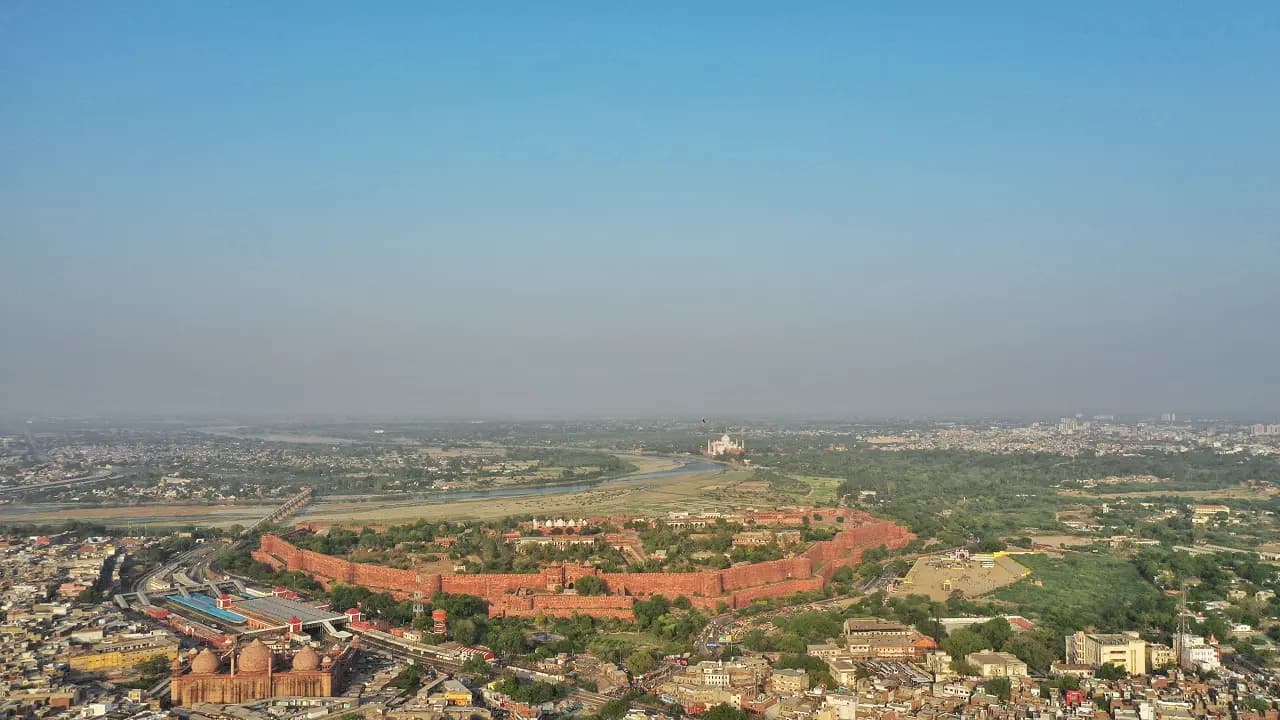
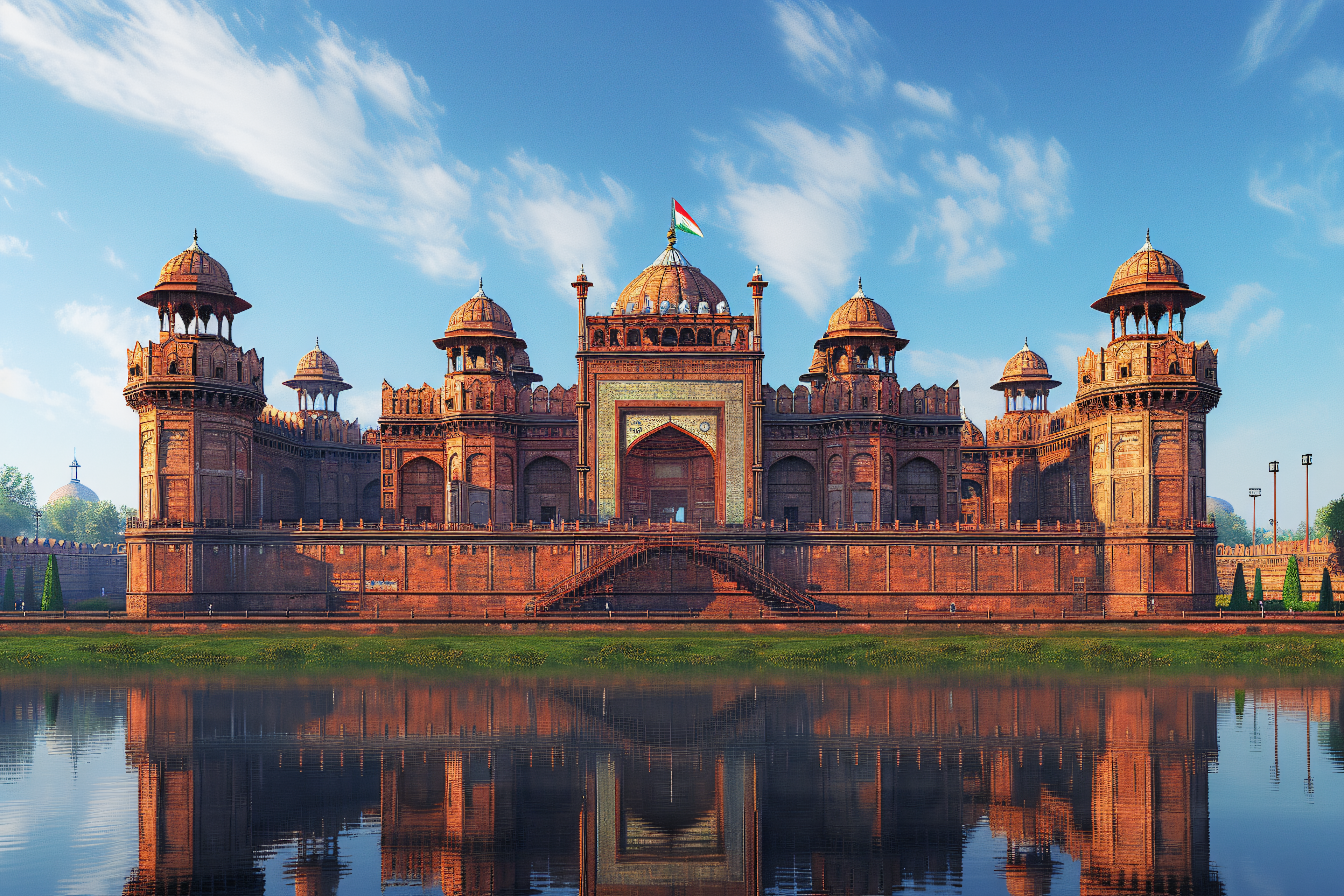
Red Fort's massive sandstone ramparts were built for defense, which makes them ideal for wide establishing drone shots. Filmmakers covering Independence Day content or Mughal history frequently use a rising aerial shot that starts at the Lahori Gate and climbs to reveal the fort's full perimeter.
4. Amber Fort, Jaipur
Perched on a hilltop with the Maota Lake below, Amber Fort offers one of India's most dramatic aerial compositions. A drone shot tracking along the fort's zigzagging defensive walls (the “Jaigarh connection”) gives filmmakers a shot that feels almost cinematic-game-world in scale.
5. Gateway of India, Mumbai
Mumbai's coastal skyline makes the Gateway of India uniquely suited to aerial shots that combine architecture with the Arabian Sea backdrop. A wide drone pass at golden hour, with the Taj Mahal Palace hotel in frame, is a staple for Mumbai tourism and lifestyle brand content.
6. Golden Temple, Amritsar
Few aerial shots carry as much emotional weight as a top-down view of the Golden Temple's gilded dome reflected in the surrounding sarovar (holy tank). This shot is frequently used in spiritual, cultural, and Punjab-tourism content because of its striking symmetry and reflective water surface.
7. Mysore Palace, Karnataka
Best captured during Dasara illuminations, an aerial shot of Mysore Palace at night — thousands of lights outlining its domes and arches — is one of the most visually rewarding (and technically demanding) shots on this list, requiring careful low-light drone settings.
Aerial Shot Planning at a Glance
Before you head out (or head to a stock library instead), here's how these seven shots stack up in terms of timing, angle, and best use:
• Taj Mahal: Best shot at sunrise, using a dome-reveal pull-back. Best suited for documentaries and tourism ads.
• Qutub Minar: Best shot mid-morning, using a slow top-down orbit. Best suited for history and education content.
• Red Fort: Best shot in the late afternoon, using a rising establishing shot from the Lahori Gate. Best suited for Independence Day features and heritage films.
• Amber Fort: Best shot at golden hour, tracking along the fort's ramparts. Best suited for travel vlogs and brand films.
• Gateway of India: Best shot at golden hour, using a wide coastal pass. Best suited for lifestyle content and tourism marketing.
• Golden Temple: Best shot early morning, using a symmetrical top-down angle over the sarovar. Best suited for cultural and spiritual content.
• Mysore Palace: Best shot at night during Dasara illuminations, using a wide illuminated shot. Best suited for festival features and social reels.
Practical Tips for Using Aerial Monument Footage Effectively
1. Shoot for the edit, not just the view. Always capture a slow pull-back and a slow push-in of the same shot — editors need both directions for pacing flexibility.
2. Match color grading to mood. Warm, golden-hour tones suit heritage and travel narratives; cooler, blue-hour tones work better for suspense or news-style content.
3. Pair wide aerials with ground-level detail shots. A drone shot of Qutub Minar's silhouette lands harder when followed by a close-up of its carved sandstone. Browsing a full aerial and drone footage collection beforehand also helps you plan complementary angles.
4. Check licensing before you cut. Verify whether footage is cleared for commercial use, especially for monuments under Archaeological Survey of India (ASI) protection, where drone flying itself may require separate permission.
5. Budget for weather contingencies. Haze is common around Delhi monuments in winter; plan flexible shoot windows or source pre-licensed aerial footage instead.
Frequently Asked Questions
Q1: Do I need a drone license to film Indian monuments?
Yes, for any commercial drone operation in India, you generally need to register your drone and pilot on the Digital Sky platform under DGCA rules, and some ASI-protected monuments require additional site-specific permissions.
Q2: Which Indian monument is hardest to get aerial permission for?
Monuments near sensitive zones (parts of Delhi and border-adjacent heritage sites) often have the strictest no-fly restrictions always check current DGCA and local police clearances before flying.
Q3: Is licensed stock footage a good alternative to shooting your own drone footage?
Absolutely — it removes permission delays, weather risk, and equipment cost, which is why many independent filmmakers and agencies license aerial monument footage instead of shooting from scratch.
Q4: What's the ideal time of day for aerial monument shots?
Golden hour (just after sunrise or before sunset) generally gives the richest color and softest shadows, though night shots work well for illuminated monuments like Mysore Palace.
Q5: Can aerial footage of monuments be used in commercial advertising?
Yes, provided the footage is properly licensed — royalty-free stock platforms typically clear this for you, unlike footage you shoot yourself without a permit.
Q6: How long should an aerial monument shot be in a final edit?
Most editors keep individual aerial shots between 3–6 seconds unless they're serving as a full establishing sequence, where 8–12 seconds is common.
Q7: What resolution should I look for in aerial monument stock footage?
4K is now the practical minimum for most commercial and broadcast use, giving you room to crop or stabilize in post without losing quality.
Conclusion: Elevate Your Next Project with Authentic Indian Aerial Footage
Aerial shots of Indian monuments aren't just visually stunning — they're a storytelling shortcut that instantly signals scale, history, and production value. Whether you're building a travel documentary, a heritage brand campaign, or a social reel, the right drone shot of the Taj Mahal, Qutub Minar, or Red Fort can do more work in seconds than pages of narration.
Instead of navigating drone permissions, weather delays, and licensing uncertainty yourself, browse Indian Stock Video for royalty-free, India-shot aerial footage of these monuments and more ready to license and drop straight into your timeline. Agencies sourcing footage at scale can also check out the Agency Partner Program for commission-based bulk licensing