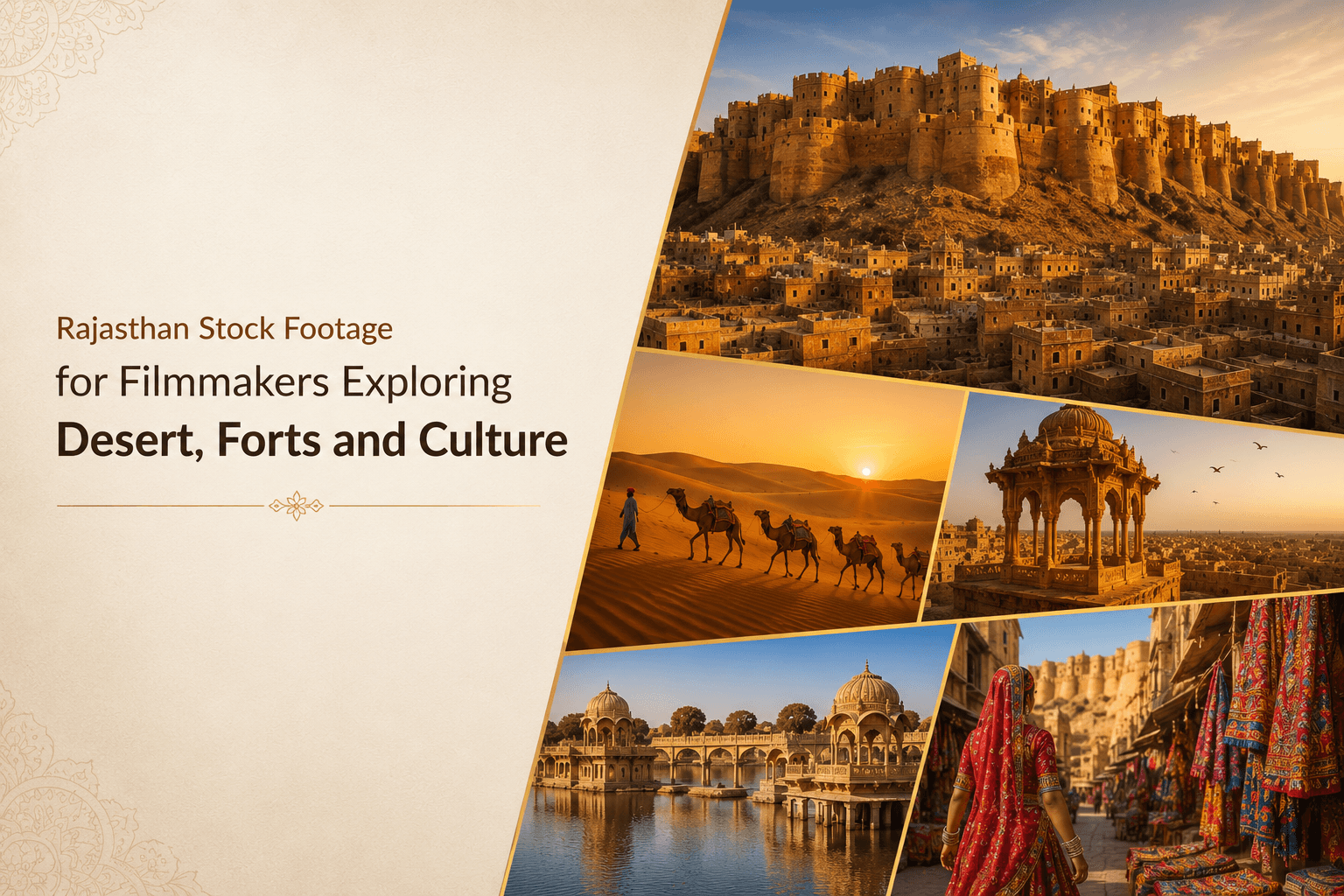
Rajasthan Stock Footage for Filmmakers Exploring Desert Forts and Culture
There are very few places in the world where golden sand dunes, centuries-old sandstone forts, and living desert culture all exist within the same frame. Rajasthan is one of them.
For filmmakers, documentary producers, and travel content creators, Rajasthan desert and fort footage offers something rare: visuals that carry both scale and history. A single wide shot of the Thar Desert at sunrise, or a drone pass over Mehrangarh Fort, can do more storytelling work than pages of narration.
This is exactly why Rajasthan footage shows up so often in documentaries, tourism campaigns, and travel films and why finding the right clips matters as much as finding the right story.
Why Rajasthan Footage Is Valuable for Filmmakers
Rajasthan sits at an unusual intersection: desert landscape, royal architecture, and a culture that hasn't been flattened by modernization. That combination makes Rajasthan stock footage useful across a wide range of formats.
Documentary teams use it to establish geography and history. Tourism boards and travel agencies use it in campaign videos to sell a destination in thirty seconds. YouTubers and independent creators use it to fill gaps in their own footage when a shoot wasn't possible. Ad agencies use it for brand films that want to borrow a sense of heritage or grandeur without an actual India shoot.
In each case, the footage is doing the same job: giving the story a place to stand.
Types of Rajasthan Desert Footage to Look For
Not all desert footage is interchangeable. If you're building a documentary or travel film, it helps to know what to look for.
Thar Desert Landscapes
Wide, uninterrupted shots of the Thar Desert are usually the backbone of any Rajasthan sequence they set scale and give the audience a sense of place before anything else happens on screen.
Desert Dunes
Close and mid-range shots of dune ridges, wind patterns in the sand, and shifting light work well for transitions and B-roll between narrative beats.
Camel Rides and Caravans
Camel caravans crossing the desert are one of the most recognizable visual signatures of Rajasthan. This kind of footage adds movement and human presence to otherwise static landscape shots.
Jaisalmer Desert
Jaisalmer desert footage golden sandstone, dunes right up to the city's edge is often treated as its own category because the light and terrain here look distinct from the rest of the Thar region.
Desert Sunsets and Sunrises
Golden-hour footage is in constant demand for travel films and tourism campaigns, since it's the shot most likely to make an audience want to visit.
Traditional Villages and Rajasthani Lifestyle
Desert villages, local markets, traditional clothing, and everyday rural life round out a sequence —they shift the footage from "landscape" to "story."
Rajasthan Fort Footage for Travel Films
If the desert gives Rajasthan its scale, the forts give it its history. A handful of forts come up again and again in documentaries and travel content because of how visually distinct they are.
Jaisalmer Fort — a living fort, still inhabited, rising directly out of the desert. Useful for shots that connect architecture with everyday life.
Mehrangarh Fort — dramatic hilltop positioning over Jodhpur, ideal for aerial and wide establishing shots.
Amer Fort — intricate architecture and courtyards near Jaipur, well suited to close-up and interior detail shots.
Chittorgarh Fort — one of the largest fort complexes in India, useful for footage that needs to convey scale and historical weight.
Kumbhalgarh Fort — known for its massive perimeter wall, strong for wide and aerial shots that emphasize isolation and defense architecture.
Rajasthan fort footage tends to work best when a project mixes shot types: aerial footage to establish scale, wide-angle shots to show the fort within its landscape, architectural detail shots for texture, and close-ups of carvings, gates, or courtyards to slow the pacing down. A documentary that only uses wide shots of a fort feels flat; mixing in detail shots is usually what makes the sequence feel authored rather than generic.
How to Choose the Best Rajasthan Stock Footage
Not every clip labeled "Rajasthan stock footage" is production-ready. Before licensing anything, it's worth checking a few things.
● Resolution — confirm actual 4K or HD, not upscaled footage
● Camera quality — look for consistent exposure and color, not just high resolution
● Stabilization — handheld desert footage can be unusable if it's shaky
● Aerial/drone availability — especially important for fort and desert establishing shots
● Licensing terms — confirm the license covers your specific use case (broadcast, ad campaign, YouTube monetization, etc.)
● Commercial usage rights — some free footage is restricted to personal or non-commercial use only
● Watermarks — preview copies should be clearly marked so you're not surprised later
● Download formats — check that the format matches your editing workflow (ProRes, MP4, etc.)
Skipping this step is one of the most common ways production teams end up re-shooting or re-licensing footage midway through post-production.
How to Use Rajasthan Footage in Documentaries
Rajasthan desert and fort footage tends to serve a few specific jobs inside a documentary edit, rather than just filling time.
Establishing shots — a wide desert or fort shot at the start of a segment tells the audience where they are before a single word is spoken.
Transitions — desert footage, especially dune and sky shots, works well as a visual bridge between interview segments or time jumps.
Historical context — fort footage paired with narration about Rajput history or Mughal-era architecture gives abstract history something concrete to look at.
Cultural storytelling — village and lifestyle footage grounds a historical or geographic narrative in present-day human life, which keeps documentaries from feeling like a textbook.
Used this way, stock footage isn't a shortcut — it's doing real narrative work alongside the parts of the film that were shot originally.
Rajasthan Footage for Travel Agencies and Brands
Documentary use is only part of the picture. Travel agencies, hotels, and destination marketers rely on Rajasthan footage just as heavily, usually under tighter timelines and budgets.
A hotel promoting a desert camp might use Thar Desert and camel caravan footage on its website and Instagram ads. A destination marketing board might build an entire campaign around Jaisalmer Fort and desert sunset shots to position Rajasthan as a bucket-list destination. Travel agencies packaging Rajasthan tours often use fort and desert footage in YouTube pre-roll ads, where the goal is to sell a feeling in the first five seconds.
For these use cases, licensed footage is usually more practical than commissioning a shoot campaigns move fast, and not every brand has the budget or timeline for an on-location crew in Rajasthan.
Why Royalty-Free Footage Can Help Production Teams
Filming in Rajasthan's forts and deserts isn't always simple. Some locations require permits, others are difficult to access seasonally, and drone filming in and around heritage sites often comes with restrictions.
Royalty-free Rajasthan footage removes several of these obstacles at once. It cuts location and permit costs, reduces production timelines from weeks to days, and gives smaller teams access to shots aerial fort footage, for instance that would otherwise require specialized equipment and permissions.
For documentary teams working with limited budgets, or brands that need content fast, licensed stock footage is often the difference between a project shipping on time and one that stalls waiting on a location shoot.
Where to Find Rajasthan Desert & Fort Footage
Indian Stock Video (indianstockvideo.com) is a royalty-free stock footage platform built around authentic, India-shot content — including desert and fort footage from Rajasthan. The catalog includes Rajasthan stock footage across resolution options, with clips sourced from Indian creators filming on location rather than staged or generic stock.
For filmmakers and agencies working specifically on Rajasthan-themed projects, the platform's Indian stock footage collection is organized to make it easier to find desert, fort, and cultural footage without sorting through unrelated global content. Licensing is priced in INR, which is worth checking if you're budgeting a project from India.
As with any footage source, it's worth confirming resolution, licensing terms, and usage rights for your specific project before downloading.
Conclusion
Rajasthan's deserts and forts offer filmmakers something genuinely rare — landscapes and architecture that carry visual weight without needing much embellishment. Whether you're building a documentary, a travel film, or a destination marketing campaign, Rajasthan desert and fort footage can anchor a story in a way that's hard to fake.
The part that matters most is choosing footage carefully — checking resolution, licensing, and usage rights before you build a project around it. Properly licensed, high-quality footage saves time in post-production and keeps a project out of legal trouble later. For creators working on Rajasthan-themed content, starting with a reliable, India-focused footage source is usually the simplest way to get there.
Frequently Asked Questions
1. What is the best type of Rajasthan footage for a documentary?
It depends on the story, but most documentaries benefit from a mix: wide desert or fort establishing shots, aerial footage for scale, and close-up cultural or architectural detail shots to slow the pacing down.
2. Is Jaisalmer Fort footage different from other Rajasthan fort footage?
Jaisalmer Fort is a living fort still inhabited by residents, which gives its footage a different character than forts like Chittorgarh or Kumbhalgarh, which are primarily historical sites.
3. Can royalty-free Rajasthan footage be used commercially?
It depends on the specific license attached to each clip. Always confirm commercial usage rights before using footage in a paid campaign, broadcast project, or monetized video.
4. Why use stock footage instead of filming in Rajasthan directly?
Some locations require permits, have drone restrictions, or are difficult to access depending on the season. Licensed footage removes these obstacles and reduces both cost and production time.
5. What resolution should I look for in Rajasthan desert and fort footage?
For most documentary and broadcast use, 4K is preferable. HD can work for social media or web content, but confirm the actual resolution rather than relying on labeling alone.